

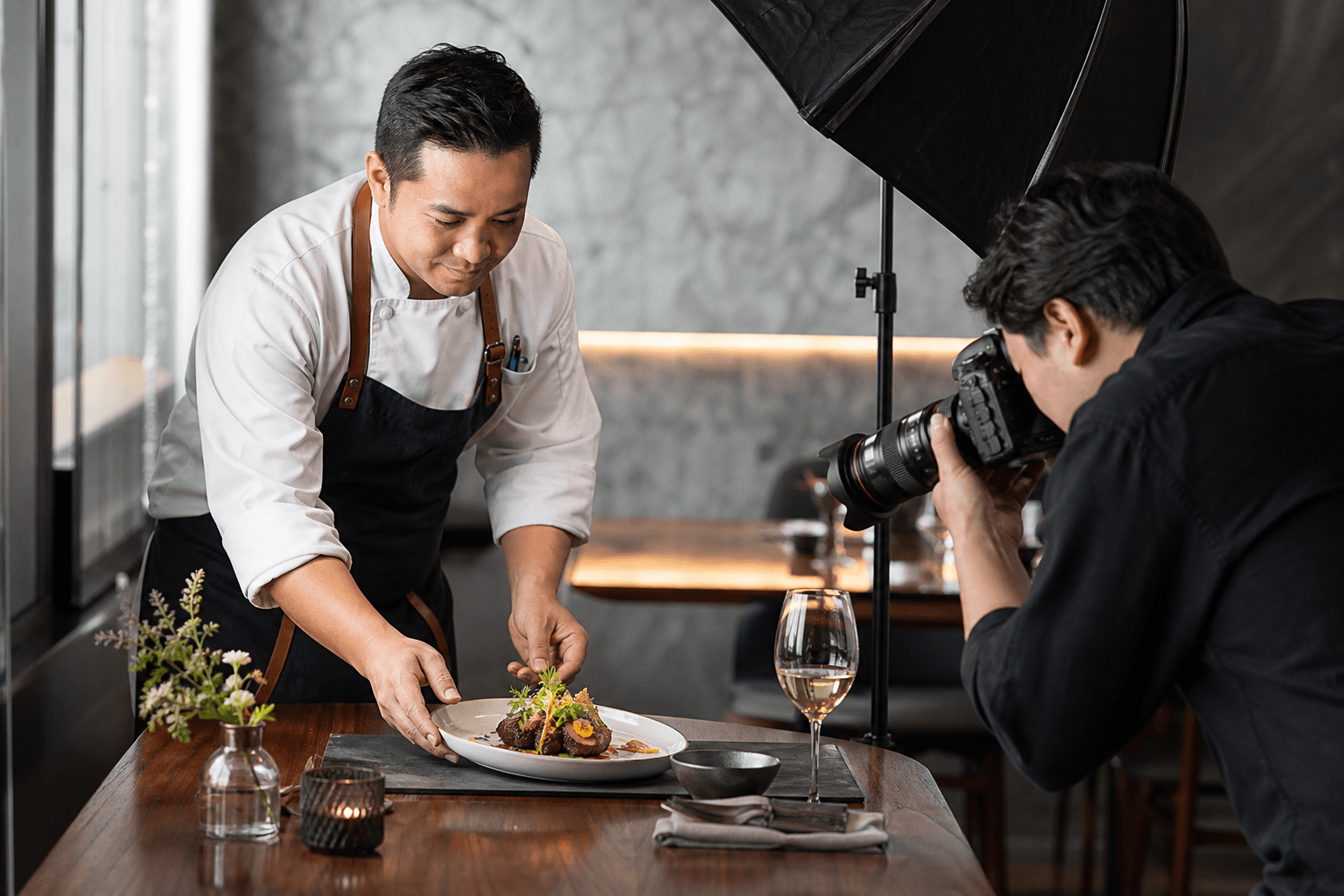
Effective restaurant menu dish photography should do more than make food look attractive. It should help customers recognize the dish, understand its defining details, and see how the image fits your restaurant’s identity across menus, websites, delivery platforms, and social media.
Start with a focused group of priority dishes, define a consistent visual direction, and plan the formats you will actually use. These seven ideas can help you prepare a more useful photography session.
Quick summary

- Prioritize signature, seasonal, newly launched, or strategically important dishes.
- Use composition to show ingredients, texture, layers, and serving context.
- Match colour, lighting, surfaces, and mood to your restaurant’s brand.
- Agree on a consistent visual system before photographing a larger menu.
- Plan portrait, landscape, close-up, and vertical content requirements early.
- Consider short promotional video for preparation, atmosphere, or movement.
- Prepare a brief covering dishes, platforms, references, and deliverables.
1. Start with the dishes customers should notice first
A first photography session does not need to cover the entire menu. Begin with signature items, seasonal specials, new launches, chef-recommended plates, or categories you are actively promoting.
Match each priority to its intended use. A signature dish may need a polished website image, while a seasonal item may need menu photography and social media content before its promotion begins. A new dish may also need supporting images that show its ingredients and presentation clearly.
Questions to ask
- Which dishes define the restaurant’s experience?
- Which items are launching or receiving promotional attention?
- Which dishes need images for menus, websites, delivery listings, or social media?
- Which categories currently lack consistent visual coverage?
- Can each dish be prepared and presented reliably during the session?
A short, prioritized list gives the shoot a clearer purpose and helps the kitchen coordinate preparation with the photographer.
2. Photograph the details that make the dish understandable

A strong dish image should communicate more than colour and shape. Consider the details that help someone understand what they are seeing: visible ingredients, layers, a crisp edge, creamy texture, distinctive garnish, portion, or serving style.
A close view may suit a dish with an interesting surface or filling, while a wider frame may be better when the plate, table setting, or shared serving context matters. Present defining characteristics clearly without creating expectations that do not match normal service.
Use the actual plateware, garnish, sauces, and portion presentation whenever possible. Temporary styling that differs from the customer’s experience can make the image less useful.
3. Match the images to the restaurant’s visual identity
A café, fine-dining room, neighbourhood bakery, and fast-casual concept may all need food images, but their use of colour, surfaces, framing, lighting, and atmosphere can differ significantly.
Before the shoot, identify the qualities you want to preserve, such as bright and clean, warm and intimate, minimal and modern, rustic and handmade, or bold and energetic. Gather examples from your website, signage, packaging, dining room, social media, and previous campaigns.
Share brand guidelines, preferred colours, and examples of unsuitable images with the photographer. This gives the creative team a clearer basis for decisions about backgrounds, props, camera angles, and the balance between food detail and restaurant atmosphere.
4. Build a consistent set instead of photographing isolated dishes
Individual images can look appealing and still feel disconnected when placed together. Consistency helps a collection work as a menu set, website gallery, delivery listing, or social media library.
Decide which elements should remain stable: background, surface, lighting direction, camera height, viewing angle, distance, colour treatment, and surrounding space. Variations can still be purposeful, but the overall system should be intentional.
Define the visual rules
- Choose overhead, low-angle, or repeatable three-quarter views.
- Decide whether the background should be neutral, textured, or connected to the dining space.
- Set an approach to props, cutlery, napkins, sauces, and garnishes.
- Determine whether each dish needs a standard menu image plus a detail or atmosphere image.
- Identify where space is needed for menu design, website layouts, or promotional text.
Consistency does not mean every photograph must be identical. It means the differences are purposeful and the images work together.
5. Plan crops that work beyond the printed menu
A single composition may not suit a menu, website banner, delivery listing, social post, story, reel cover, and printed promotion. Tell the photographer where images will appear before the session.
Portrait, landscape, square, close-up, and wider compositions can each serve a different purpose. Cropping later may remove a garnish, plate edge, key ingredient, or space needed for text.
For regular social media content, discuss vertical video and vertical stills in advance. A social-first approach can make a food launch easier to adapt across posts, stories, and short-form promotional material.
6. Consider photography and short promotional video together
Still photography shows a dish clearly, while movement can communicate preparation, plating, steam, pouring, kitchen activity, dining-room atmosphere, and the people behind the experience.
Consider combining photography with promotional video for a restaurant launch, new menu, signature item, or broader social media content library. Video does not replace clear dish images. It serves a different purpose by showing energy, process, atmosphere, or a sequence of moments.
Keep the priorities distinct. Still photography may require controlled plating and composition, while video may need timing, movement, sound considerations, and a sequence that works on screen.
Silver Valley Studios provides restaurant promotional content alongside photography, videography, vertical video, and broader brand content services. Its restaurant work uses a collaborative approach focused on understanding the client’s vision.
7. Prepare a focused brief before booking the shoot
A clear brief turns a general request for food photos into a practical creative assignment. It gives the restaurant, kitchen, and photographer a shared understanding of what needs to be created and where it will be used.
Include these details
- Priority dishes: List signature, seasonal, new, or time-sensitive items.
- Platforms: Note menus, websites, delivery listings, social media, advertising, or other uses.
- Visual direction: Describe the mood and provide brand references or examples to avoid.
- Formats: Identify portrait, landscape, square, vertical, close-up, wider scene, photo, and video needs.
- Food preparation: Confirm who will prepare each dish and how plating will be coordinated.
- Location: Note whether the shoot includes the dining room, kitchen, staff, packaging, or exterior.
- Approval: Identify who will review the creative direction and priorities.
Confirm scope, creative direction, deliverables, image counts, licensing, turnaround, and delivery formats directly with the photographer before the session.
When professional restaurant photography makes sense
Phone photography can suit an occasional informal update or a small number of images. Professional support becomes more useful when you need a cohesive menu set, repeatable styling, multiple orientations, controlled lighting, detailed presentation, or content for several channels.
It is also worth considering when a launch or promotion requires coordination between the kitchen, brand direction, still photography, and video. Silver Valley Studios offers restaurant photography and promotional content from its Maple Ridge base, serving Greater Vancouver and Vancouver Island communities.
Restaurant menu dish photography FAQ
Which dishes should a restaurant photograph first?
Begin with signature dishes, new launches, seasonal items, chef-recommended plates, or categories needing better visual coverage. Match each priority to its intended use, such as a menu update, website feature, delivery listing, social campaign, or promotional launch.
How can menu photos look consistent across different dishes?
Agree on camera angle, lighting direction, backgrounds, surfaces, props, colour treatment, spacing, and orientations before photographing the full set. Allow thoughtful variations while keeping the collection recognizably connected.
When is phone photography enough for a restaurant menu?
Phone photography may be enough for occasional informal updates when the number of images is small. Professional work is more suitable for a larger menu library, repeatable styling, controlled presentation, multiple formats, or polished content across several platforms.
Should a restaurant plan photography and video in the same shoot?
It can make sense for a menu launch, signature dish promotion, or wider content library. Plan still and video priorities separately because they require different compositions and production considerations, then coordinate them in one brief.
Choose the dishes and formats that support your next promotion
Useful restaurant menu dish photography starts with decisions, not equipment. Choose the dishes that matter most, define how they should look, agree on a consistent visual system, and identify the platforms and formats that give the images a clear purpose.
If you also need social media content, vertical video, restaurant atmosphere, or promotional storytelling, include those needs before booking. Restaurant owners can book Silver Valley Studios for restaurant photography and promotional content through its online booking portal.