

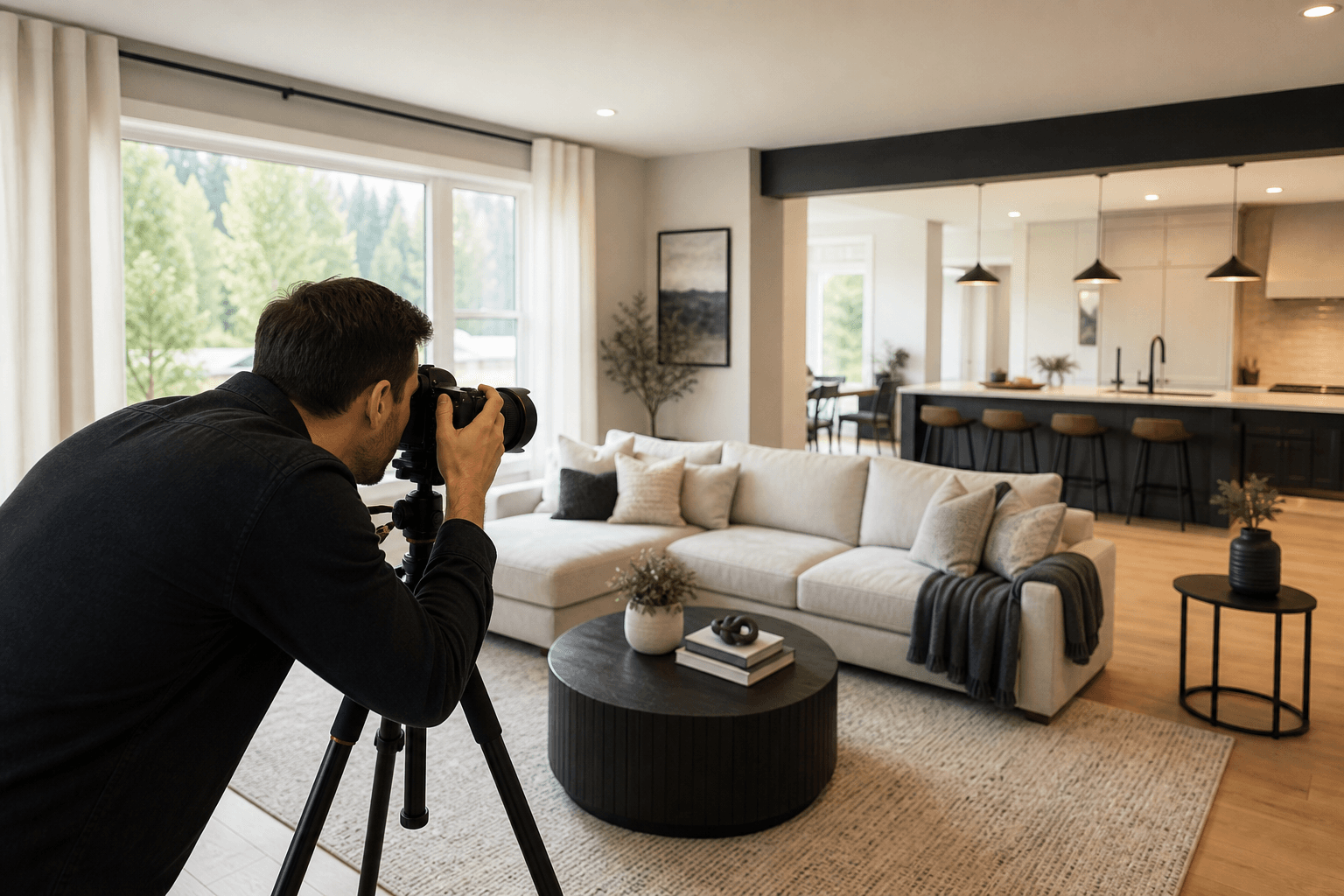
The right real estate photography techniques depend on the property, its lighting, the story you need to tell and where the content will appear. Clear still photography is usually the foundation, while property video tours, vertical video, 2D floorplans and drone coverage each solve a different communication problem.
Instead of ordering every available format, compare each technique by its contribution, best use case, limitations and booking requirements. This helps realtors and property teams create clear, consistent media suited to the listing.
Quick summary

- Use naturally balanced HDR photos as the core gallery for interiors, exteriors, finishes and features.
- Add a property video tour when movement, room transitions or atmosphere are difficult to show in still images.
- Choose dedicated vertical video for social-first promotion rather than assuming a conventional tour will adapt perfectly.
- Use 2D floorplans to clarify relationships between rooms, levels and spaces.
- Consider drone photography or drone videography when views, land, surroundings or development scale matter.
At a glance: which technique fits which listing need?
None of these options is automatically necessary for every listing. The best combination depends on the property’s strongest features, target audience and marketing channels. Silver Valley Studios’ real estate photography services include photos, video, floorplans and drone coverage for coordinated campaigns.
| Technique | Main contribution | Often useful for | Confirm before booking |
|---|---|---|---|
| Balanced HDR photos | Polished, consistent views of interiors and exteriors | Most residential galleries | Whether editing remains natural across rooms |
| Composition and perspective | Clearer understanding of size, flow and features | Small rooms, open plans and feature-led homes | Which spaces and details receive priority |
| Lighting control | More even presentation between interiors and windows | Rooms with difficult or mixed lighting | How consistency will be maintained |
| Property video tours | Movement, transitions, atmosphere and progression | Distinctive, larger or lifestyle-led properties | Coverage, format and intended channel |
| Vertical video | Short-form, social-first promotion | Realtor marketing and social campaigns | Orientation, branding and editing scope |
| 2D floorplans | Visual explanation of layout and spatial relationships | Multi-level or unusual homes | Scope, presentation and accuracy expectations |
| Drone coverage | Exterior context, views, land and scale | Acreage, developments and view properties | Aerial deliverables, access and weather considerations |
1. Naturally balanced HDR photos for the listing foundation

Still photography lets viewers inspect a property at their own pace. HDR photos blend exposures to present interior areas, windows and brighter or darker parts of a room in a more balanced image. The goal is not simply to make a photograph brighter, but to represent the property clearly while keeping the result believable.
The key comparison is balanced HDR processing versus an overly processed appearance. Excessive brightness, unnatural colour or inconsistent treatment between rooms can distract from the property. Review complete galleries rather than only a few portfolio highlights, and look for a clean, naturally balanced style across kitchens, living spaces, bedrooms and bathrooms.
Ask which rooms, exterior areas and details are included, how bright windows will be handled, whether the editing will align with your team’s existing media and whether feature images are included. Silver Valley Studios’ real estate photography basics provide additional planning context.
2. Composition and perspective for clear property presentation
Composition affects whether viewers understand how a space is arranged. Camera position, sightlines and room sequencing influence whether a home feels coherent online. A technically clean image can still be unhelpful if it hides the connection between spaces or gives an important room too little attention.
For smaller rooms, ask how useful context will be shown without making the space feel misleadingly distorted. In open-plan areas, discuss the relationships that matter most, such as the kitchen and living room, indoor-outdoor access or work and living zones. For feature-led homes, identify the architectural details, views and finishes that should anchor the gallery.
Give the photographer the property’s priorities rather than dictating every frame. A professional can then plan a sequence that lets viewers move logically from one space to the next. Silver Valley Studios also offers property photo guidance for planning considerations.
3. Lighting control for consistent interiors
Rooms can contain several competing light sources: bright windows, darker corners and mixed colour temperatures. If each image is handled differently, the gallery may feel uneven. The better question is not simply whether images should look bright, but whether they look inviting while still representing the room’s character.
Ask how difficult windows and mixed interior lighting will be handled, whether the provider can show a complete gallery and how the approach will work across rooms with different orientations and finishes. Also check whether the final images will match the treatment used in video and social assets.
Silver Valley Studios describes its visual approach as clean, naturally balanced imagery using HDR blending and cinematic camera work. Compare that style with your listing and brand expectations before booking.
4. Property video tours when movement and flow matter
A property video tour adds movement and progression to the listing story. Rather than asking viewers to infer how spaces connect from separate images, video can lead them through transitions, atmosphere and the overall rhythm of the home.
Video does not replace still photography. Photos allow detailed inspection, while a tour provides a broader sense of flow. They should therefore feel like parts of one campaign, with compatible colour, pacing and priorities.
Consider a tour for distinctive architecture, larger properties, lifestyle-led listings or developments that need a cinematic introduction. Confirm the intended use, format, coverage, music or narration expectations and whether the video is designed for a listing page, website, social media or several channels. Silver Valley Studios offers cinematic 4K video and property video tours.
5. Vertical video for social-first listing promotion
Vertical video has a different purpose from a conventional property tour. It is planned for short-form, mobile-oriented viewing and may highlight one feature, create a quick walkthrough or provide a reusable promotional asset. It should not automatically be treated as a horizontal tour placed into a vertical frame.
Decide whether the goal is to introduce the listing quickly, focus on a renovation, show a view or support the agent’s wider social media content. Then ask whether the video is captured and edited as a dedicated social-first deliverable, which branding and calls to action can be included, which channels it suits and whether several short pieces can be created from one shoot.
Silver Valley Studios produces vertical video for real estate and small-business social media content. Confirm the exact deliverables instead of assuming every video package includes every version.
6. 2D floorplans for spatial understanding
Photographs show rooms, but they do not always explain how those rooms relate. A 2D floorplan supplements the gallery with a visual reference for layout, levels, room placement and flow. It can be particularly useful for multi-level homes, unusual arrangements or properties where spatial relationships are important.
Ask whether the plan covers the full property or selected levels, how rooms will be labelled, what information will be shown and how the finished plan will be presented with the other media. Floorplans complement rather than replace photographs and video.
7. Drone photography and videography for exterior context
Drone coverage can show context that is difficult to capture from ground level, including the relationship between a home and its lot, surrounding landscape, notable views, approach or the scale of a development.
Aerial stills and aerial video are not interchangeable. A still can provide a clear reference point, while video adds movement and a broader sense of place. Choose the format according to the information viewers need.
Drone coverage may be less useful when the surroundings add little context, but it can be valuable for acreage, view properties, architecturally distinctive homes, developments and commercial projects. Confirm which exterior features should be shown, whether you need photos, video or both, how weather and access affect the plan and whether the aerial visuals will match the ground-based media. Silver Valley Studios offers drone and aerial photos and video.
Match the technique mix to the property and campaign
| Property or campaign | Sensible starting mix | What should drive additions? |
|---|---|---|
| Standard residential listing | Consistent still photography, with a floorplan if layout needs explanation | Property size, unusual rooms and outdoor areas |
| Luxury home | Polished stills, a property tour and possibly aerial coverage | Architecture, views, landscaping and lifestyle |
| New development | Photo and video, floorplans and selected aerial or site visuals | Whether buyers need unit, amenity or site context |
| Commercial space | Commercial photography focused on layout, finishes, access and usable features | Leasing context, workspaces, branding or exterior context |
| Social-first campaign | Still photography plus dedicated vertical video | Content volume, brand elements and reuse requirements |
Silver Valley Studios serves realtors, developers, restaurants, small businesses, fitness brands and commercial projects across Maple Ridge, Greater Vancouver and Vancouver Island. Its service overview can help you compare categories, but the final brief should remain property-specific.
The overlooked comparison: consistency, style and workflow
Comparing techniques alone is not enough. A campaign can include all the right formats and still feel fragmented if the photography, video, floorplan and aerial content do not work together.
Review complete projects for consistency in colour, brightness, perspective, pacing and feature priorities. Ask how the provider gathers priorities, confirms scope, communicates updates and handles questions. You should know what is included, what is optional and how the final files will be supplied.
Supplied review analysis for Silver Valley Studios reports recurring positive themes around service range, property presentation, professionalism, collaboration and turnaround reliability. These are useful business context, not guarantees of a particular result. Learn more about the studio’s approach on its About Us page.
A vendor brief for comparing real estate media options
- Property priorities: List rooms, views, finishes, outdoor areas, amenities and architectural features that must be represented.
- Visual style: Explain whether you want a clean, naturally balanced presentation.
- Required formats: Identify photos, HDR photos, video, vertical video, floorplans, drone photos or drone video.
- Marketing channels: State whether content is for listings, websites, social media, development presentations or commercial materials.
- Branding: Confirm agent, team, brokerage or development branding needs.
- Coverage: Ask which rooms, exterior areas and aerial perspectives are included.
- Delivery: Confirm file types, deliverables, delivery process and project timing in writing.
- Revisions and usage: Ask how changes are handled and what reuse is included.
Silver Valley Studios provides an online booking and pricing portal for scoped media options. A clear brief makes that process more useful because you already know which techniques answer the listing’s needs.
Frequently asked questions
Does every listing need HDR photos, video, floorplans and drone coverage?
No. Still photography is usually the starting point. Add other formats when they explain something important about the property or support a defined campaign.
How should a realtor compare a property video tour with vertical video?
Compare intended use first. A property tour communicates movement, flow and atmosphere across the home. Vertical video is a social-first asset that may focus on a feature or short promotional sequence. Confirm orientation, branding, editing and reuse.
What should I confirm before booking a real estate media provider?
Confirm visual style, coverage, formats, floorplan scope, aerial needs, branding, delivery expectations and how the assets will work together. Request the agreed deliverables in writing.
Choose the technique mix that explains the property best
Real estate photography techniques are most useful when they answer specific viewer questions. Start with clear, consistent still photography. Add a property video tour when movement matters, vertical video for social-first content, a 2D floorplan when layout is difficult to understand and drone coverage when exterior context adds meaningful information.
Compare providers on more than the number of formats offered. Review style, consistency, communication, workflow and exact deliverables. The strongest brief is not the one that requests everything, but the one that gives each selected technique a clear job.
To discuss real estate media for a property in Maple Ridge, Greater Vancouver or Vancouver Island, visit Silver Valley Studios Inc.’s online booking and pricing portal to review options and scope a project.