

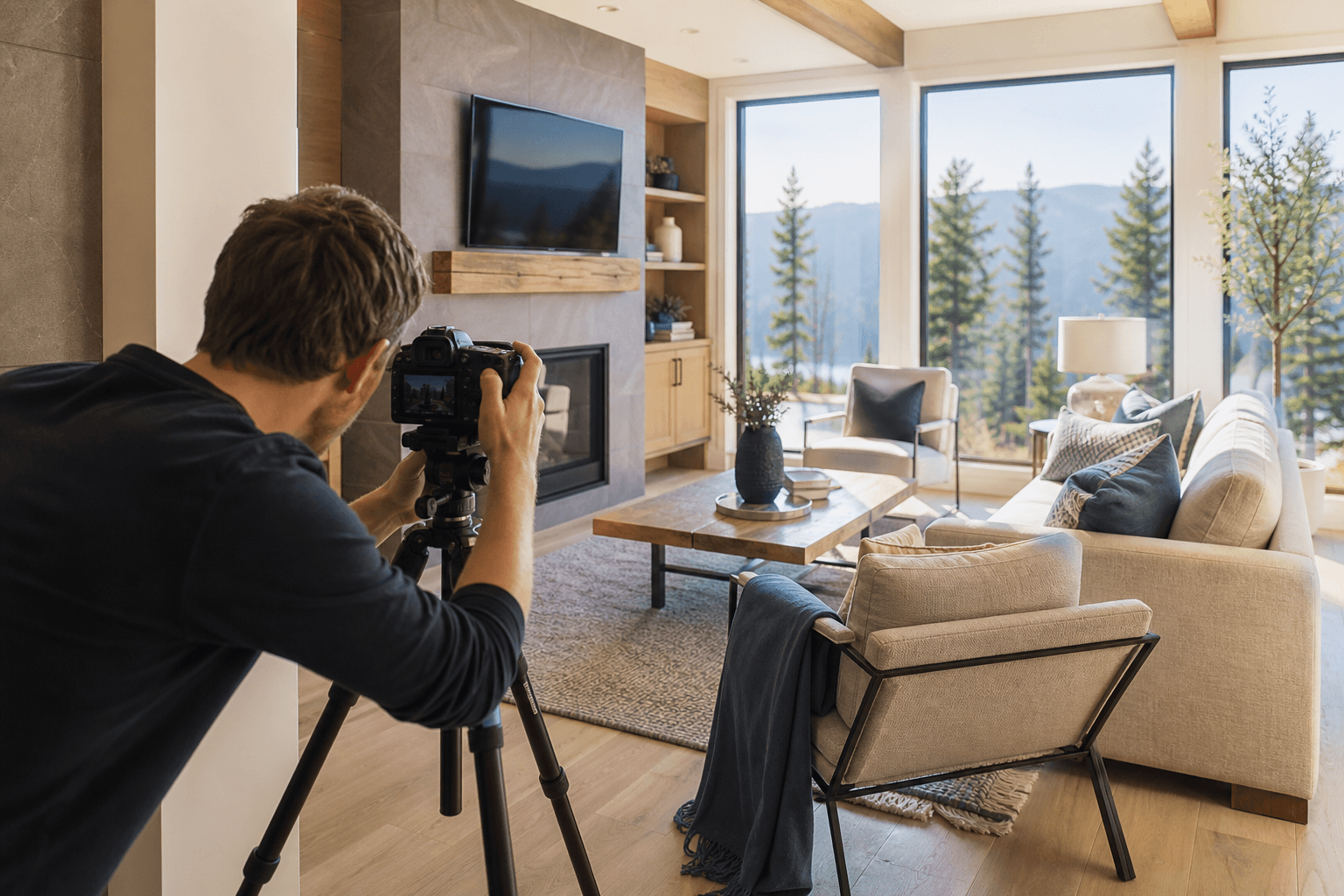
Real estate media ROI is not proven simply because a property sells after professional photos or video are published. A useful evaluation connects the cost and scope of the media to a defined objective, then compares measurable signals such as views, saves, inquiries, showing requests, delivery speed, and, where possible, transaction outcomes.
The right question is not “Which format guarantees a return?” It is “Which media mix supports this listing’s marketing goal, and how will I measure its contribution?” The comparison and worksheet below help realtors, teams, and property developers make that decision without treating illustrative examples as client case studies or guaranteed results.
Quick summary

- Define the objective first, such as earning attention, explaining layout, showing lifestyle, or creating social content.
- Compare photos, video, vertical clips, 2D floorplans, and drone media by their role in the buyer journey, not by format alone.
- Track leading indicators such as views and saves alongside qualified inquiries, showing requests, and time saved.
- Use your own media cost and outcome data for ROI calculations. The examples in this article are hypothetical.
What real estate media ROI actually measures
Return on investment can mean different things in a listing campaign. Direct financial ROI considers whether the value attributed to the media exceeds its cost. Marketing ROI may instead focus on qualified inquiries, showing activity, or stronger engagement. Operational ROI considers whether coordinated production saves preparation time or reduces the effort required to create content for several channels.
Before estimating ROI, compare real estate videography pricing by considering video value drivers such as story, coverage, format, and turnaround, not just camera time. A larger property, multiple deliverables, drone coverage, or both horizontal and vertical formats can change the scope before any marketing result is measured.
A practical measurement sequence looks like this:
- Exposure: impressions, listing views, video plays, and reach.
- Engagement: watch time, saves, shares, clicks, and repeat visits.
- Qualified interest: relevant inquiries, showing requests, and attendance.
- Commercial outcome: offers, accepted offers, sale terms, or other outcomes tracked by the listing team.
- Efficiency: time to delivery, preparation time, reuse across channels, and effort saved.
These stages are related, but they are not interchangeable. A high view count does not prove a sale, and a sale does not prove that one media asset caused the result. Use the stages together to build a more complete picture.
Compare listing media by objective, not by format alone

A complete media set may include HDR or professional photos, cinematic property video tours, vertical video, 2D floorplans, and drone photography or videography. Each asset can answer a different buyer question. The studio’s published offering describes these formats as coordinated, listing-ready deliverables, but the most suitable combination still depends on the property and campaign.
| Asset | Primary marketing role | Useful signals | Main tradeoff |
|---|---|---|---|
| Professional or HDR photos | Create the first impression and communicate condition, light, finishes, and room sequence. | Listing views, photo engagement, saves, inquiries, and showing requests. | Photos may not explain movement, scale, or the relationship between rooms as clearly as video or a plan. |
| Property video tours | Show flow, atmosphere, features, and lifestyle through a guided visual narrative. | Plays, watch time, completion rate, shares, clicks, and inquiries. | Production and editing require more planning, and viewers may not watch the full piece. |
| Vertical video | Reach social audiences with short, mobile-first content that can be reused in reels and similar channels. | Reach, retention, shares, profile visits, and listing-page clicks. | Short-form attention does not automatically translate into qualified buyer interest. |
| 2D floorplans | Clarify room relationships, circulation, and approximate layout for buyers comparing properties remotely. | Plan views, saves, inquiries about layout, and showing requests. | A plan supports understanding but does not replace visual presentation or professional measurement decisions. |
| Drone photography and videography | Provide context about the lot, surroundings, exterior scale, views, or property setting. | Aerial plays, saves, shares, location-related inquiries, and engagement with exterior assets. | Weather, location, permissions, and property context can affect whether aerial coverage adds meaningful value. |
| Complete media set | Support several stages of the buyer journey with cohesive assets across MLS, social media, print, and direct sharing. | Combined campaign activity, inquiries, showings, delivery efficiency, and reuse. | Broader coverage increases scope, so the package should match the listing objective and available budget. |
A complete media set can make ROI easier to evaluate because real estate photography and video support different stages of the buyer journey, from initial clicks to booked showings. That does not mean every property needs every format. It means the decision should reflect what buyers need to understand and where they will encounter the listing.
Real estate media ROI examples using hypothetical scenarios
The following real estate media ROI examples are deliberately hypothetical. They show how to structure a decision and measurement plan. They do not describe Silver Valley Studios client results, and they contain no assumed prices, conversion rates, or sales outcomes.
1. Launch-focused listing
Objective: Make the listing’s first impression clear and appealing when it launches. Possible mix: professional photos, selected exterior coverage, and a concise property video tour. Track: listing views during the launch period, photo engagement, video plays, saves, inquiries, and showing requests.
This example is useful when the main challenge is getting enough qualified attention at the start. If views increase but showing requests do not, the team should examine pricing, property fit, listing information, distribution, and audience quality rather than assuming more media is the answer.
2. Complex-layout property
Objective: Help remote buyers understand how rooms connect and whether the layout suits their needs. Possible mix: professional photos, a property video tour, and a 2D floorplan. Track: plan downloads or views where available, layout-related questions, showing requests, and feedback from agents or buyers.
Here, the value may appear first as reduced uncertainty rather than immediate financial return. If inquiries become more specific or fewer prospects reject the property because they misunderstood its layout, that is useful evidence, although it still does not isolate the effect of any single asset.
3. Lifestyle or location-led listing
Objective: Show how the property relates to its lot, outlook, setting, or outdoor features. Possible mix: professional photos with carefully selected drone photography or videography. Track: engagement with exterior and aerial assets, shares, location-related questions, and showing requests.
Drone media is most sensible when context is part of the property’s appeal. It may be less valuable when nearby surroundings add little to the decision or when conditions prevent useful coverage. The correct comparison is not “drone versus no drone” in general, but whether aerial context answers an important buyer question for this listing.
4. Social-first campaign
Objective: Create reusable content for a realtor, team, developer, or listing launch across social channels. Possible mix: vertical video alongside core listing photos and, where appropriate, a longer property tour. Track: reach, retention, shares, profile visits, clicks to the listing, and inquiries that identify social media as the source.
A social campaign can generate attention beyond the listing portal, but reach alone is not a transaction result. Add a simple source question to inquiry forms or conversations so the team can distinguish general awareness from qualified interest.
When a complete media set may be easier to evaluate
Using one coordinated provider for photos, video, measurements, floorplans, and drone coverage can simplify production. Silver Valley Studios describes a workflow in which multiple deliverables can be captured during one appointment, then edited for MLS, social media, and print. For a busy team, the time saved preparing the property once and repurposing the assets may be part of the investment’s value.
The tradeoff is production complexity. More coverage can require a clearer story, additional formats, suitable weather, more post-production, and a realistic delivery schedule. Property size and the intended audience also matter. A compact listing may need a focused set, while a large, distinctive, or location-led property may benefit from broader coverage.
For a balanced decision, assign each proposed asset a job. If nobody can explain which buyer question it answers, which channel will use it, or which signal will be tracked, it may be an unnecessary addition rather than a stronger investment.
Build a simple real estate media ROI worksheet
Create one row for each listing and record the following before the shoot:
- Scope and cost: media deliverables, quoted cost, usage, formats, and expected delivery date.
- Objective: attention, layout clarity, lifestyle presentation, social reach, qualified inquiries, or production efficiency.
- Baseline: comparable listing views, typical inquiry volume, average showing activity, or the team’s usual content-production time.
- Channels: MLS, brokerage website, social platforms, email, print, paid promotion, or direct buyer sharing.
- Results: views, plays, watch time, saves, shares, clicks, inquiries, showing requests, attendance, offers, and source information.
- Efficiency: time spent preparing the property, coordinating vendors, resizing assets, and publishing content.
Two simple calculations can provide an initial view:
- Cost per qualified inquiry: total media cost divided by qualified inquiries attributed to or influenced by the campaign.
- Cost per showing request: total media cost divided by showing requests attributed to or influenced by the campaign.
Do not calculate these figures if the denominator is unreliable. A better worksheet may separate “directly attributed,” “assisted,” and “unknown” outcomes. For financial ROI, use a value your business can defend, such as documented incremental revenue or a clearly defined internal value for a qualified opportunity. Avoid assigning an arbitrary dollar value to every view.
For broader investment decisions, the same discipline applies beyond property marketing. Questions about assumptions, downside risk, and evidence can also be useful when reviewing other investment decisions, as illustrated by these ROI questions and red flags.
What your numbers can and cannot prove
Listing price, staging, condition, season, audience, distribution, competition, agent activity, and market conditions can all affect results. A listing that receives more inquiries after new media may have benefited from several changes at once. Likewise, a quiet campaign does not necessarily prove that the media was ineffective.
Testimonials can demonstrate client experience, including satisfaction with professionalism, communication, quality, or the working process. They do not establish a guaranteed financial return or prove that media alone caused a sale. Treat them as qualitative evidence, not as a substitute for listing-specific measurement.
In British Columbia, real estate advertising must not contain a false or misleading statement or misrepresentation concerning real estate or real estate services, as set out in the Real Estate Services Rules. That makes careful wording important when reporting media performance. Describe what was measured, over what period, and what the data can reasonably support.
Pre-booking checklist for a more measurable media investment
- What is the listing’s primary objective?
- Who is the target buyer, and what information will that buyer need?
- Which property features require photos, video, a floorplan, or aerial context?
- Which deliverables are needed in horizontal and vertical formats?
- Where will each asset be published or reused?
- What is the launch date, and how much time is available for editing and review?
- Which baseline metrics will be recorded before publication?
- How will inquiries and showing requests be attributed or classified?
- What result would count as useful progress, even if a transaction cannot yet be measured?
Questions to ask before choosing a media package
Ask which deliverables are included, which formats will be supplied, and whether the package covers the channels you actually plan to use. Confirm how property size and production complexity affect the scope, rather than comparing packages only by the number of photos or minutes of video.
Also ask how multiple deliverables can be coordinated, whether photos, video, drone, and measurements can be completed during one appointment, and when the edited assets will be ready. A package is easier to evaluate when the objective, deliverables, usage, schedule, and success signals are agreed before production begins.
FAQ
How do you calculate ROI for real estate photography?
Start with the total media cost and define the outcome you want to evaluate, such as qualified inquiries, showing requests, or documented incremental revenue. Divide the cost by the reliable outcome count for a cost-per-result view, then compare it with an appropriate baseline. Do not claim financial ROI from views or a sale alone.
Which listing-media metrics should a realtor track first?
Begin with listing views, photo engagement, video plays and watch time, saves, shares, inquiries, and showing requests. Add source information so you can distinguish MLS, social, email, paid promotion, and direct referrals. Track offers or sales separately because they are affected by many factors beyond media.
Can property video tours prove that a listing sold faster?
Not by themselves. A video tour may contribute to awareness, understanding, or qualified interest, but proving a faster sale requires reliable comparison data and control for pricing, property condition, market timing, distribution, and other changes. Report the association carefully unless your data supports a stronger conclusion.
Are 2D floorplans and drone media worth including in every listing package?
No single asset is necessary for every property. A floorplan may be especially useful when layout is difficult to understand, while drone media may help when the setting, lot, views, or exterior context matter. Choose each deliverable because it answers a buyer question and has a planned channel and measurement signal.
Conclusion: choose the media mix you can measure
The strongest real estate media ROI examples are not promises of faster sales or higher offers. They are clear comparisons between an objective, a media deliverable, a measurable signal, and the limitations of the available evidence.
Start with the buyer question your listing needs to answer. Choose photos for presentation, video for flow and story, vertical content for social distribution, floorplans for layout clarity, and drone media for meaningful property context. Then record the cost, scope, baseline, channels, and outcomes so the next decision is based on your own evidence.
Silver Valley Studios Inc. provides real estate photography, videography, 2D floorplans, drone media, and related listing content across Maple Ridge, the Fraser Valley, Metro Vancouver, and Vancouver Island. To review available media options for a listing, visit Silver Valley Studios Inc.