

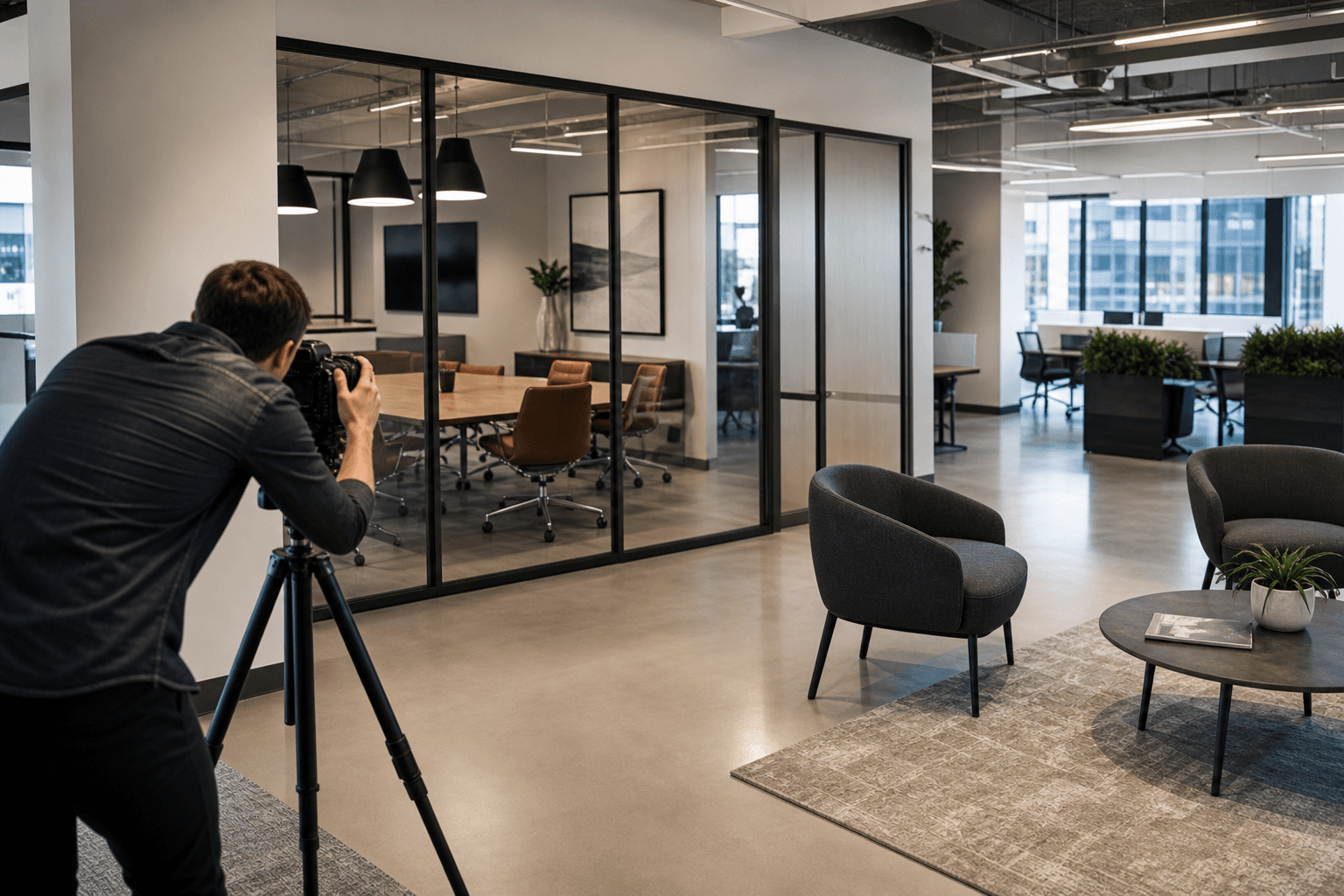
Commercial photography can help prospective tenants understand a space before they arrange a viewing, but the strongest results come from a clear leasing-marketing brief. Start with the property’s purpose, audience, layout, and priority features, then choose only the photography, video, drone, and floorplan assets that answer real questions.
This is a marketing decision, not lease-negotiation or legal advice. In British Columbia, commercial tenancies are contractual arrangements that can vary substantially, so the written agreement should establish the commercial terms separately from the images used to promote the property. British Columbia’s guidance on commercial tenancies explains this distinction.
Quick summary

- Define whether you are marketing a suite, floor, storefront, industrial site, development, or broader commercial opportunity.
- Use photography to show scale, circulation, condition, frontage, and important details without exaggerating the space.
- Add video, drone coverage, or 2D floorplans only when they communicate information still images cannot.
- Give every photographer the same written scope so you can compare deliverables, licensing, turnaround, revisions, insurance, and site requirements.
- Verify measurements, amenities, access, availability, and usage rights before publishing the final assets.
1. Define the leasing goal before planning the shoot
The first question is not “How many photos do we need?” It is “What decision should these visuals help a prospective tenant make?” Marketing a retail storefront, leasing an office suite, promoting warehouse capacity, and presenting a development site require different priorities.
Write a short objective before contacting photographers. State whether the campaign is intended to attract a tenant, promote a sale, support a development presentation, or introduce a commercial location to potential operators. Then identify the main property features, intended channels, deadline, and people who must approve the final files.
A leasing brief might say: “Show how a professional services tenant could use this office suite, including the entrance, reception area, work areas, meeting rooms, natural light, parking, and surrounding access.” That direction is more useful than asking for attractive images without defining what the viewer needs to understand.
2. Decide what prospective tenants need to understand

Strong commercial property photography does more than make a room look spacious. It should help viewers assess whether the property appears suitable for their operation, customers, staff, equipment, or brand.
List the practical questions a tenant is likely to ask. For an office, these may involve layout, meeting areas, light, entrances, and shared amenities. For retail, frontage, signage opportunities, customer approach, display areas, and surrounding context may matter more. For industrial space, loading, vehicle access, ceiling height, yard areas, and circulation can become central.
| Leasing objective | Useful visual emphasis |
|---|---|
| Lease an office suite | Entry sequence, work areas, meeting rooms, amenities, light, and circulation |
| Market a retail unit | Storefront visibility, frontage, customer approach, display areas, and surrounding context |
| Promote industrial space | Ceiling height, loading, vehicle movement, warehouse depth, yard space, and access |
| Present hospitality or restaurant space | Guest flow, dining atmosphere, kitchen or service areas, exterior arrival, and brand details |
| Support a development or investment presentation | Site relationships, building form, access, surroundings, progress, and broader context |
Separate confirmed facts from visual impressions. A photograph can show an entrance or loading area, but it does not establish permitted use, accessibility compliance, zoning approval, floor area, or lease availability.
3. Request angles that communicate scale and layout
Ask for a deliberate shot list instead of a collection of attractive viewpoints. Corner-wide views can show depth and two intersecting walls, while eye-level images usually provide a more familiar sense of how a person experiences the space. High-angle views can clarify floor area, and carefully controlled tilt-up views can help communicate vertical scale.
Infrastructure and detail images also have a practical role. Include features such as entrances, ceiling systems, electrical or plumbing points where relevant, loading doors, signage locations, finishes, fixtures, and outdoor connections. The right details depend on what the intended tenant needs to assess.
Before booking, review the commercial space photography angles that make a leased property’s scale, circulation, and layout easier to understand. The aim is accurate perspective, not extreme wide-angle distortion that makes rooms appear larger or relationships appear different from reality.
Ask to see relevant portfolio examples at full size. A photographer who is strong with residential interiors may not automatically demonstrate the framing, technical control, or operational understanding needed for office, retail, industrial, or hospitality spaces.
4. Add video, drone coverage, or 2D floorplans when photos are not enough
Still photography is often the foundation of a leasing campaign, but it cannot communicate every type of information. Choose supporting media according to the unanswered questions in your brief.
- Commercial property video: Useful for showing movement through the space, arrival, atmosphere, and the relationship between major areas.
- Vertical video: Helpful when the campaign includes social-first promotion. Ask for a specific vertical deliverable rather than assuming a horizontal edit can be cropped effectively.
- Drone photography or videography: Valuable when site context, frontage, access routes, yard space, rooflines, neighbouring uses, or a larger parcel matter to the leasing decision.
- 2D floorplans: Useful when viewers need to understand dimensions, adjacency, circulation, and how rooms or zones relate to one another.
Do not automatically purchase every format. A small office suite may need carefully composed stills and a floorplan, while a large industrial site may benefit more from aerial context and video. Silver Valley Studios’ commercial media planning describes combining HDR photography, cinematic video, drone coverage, and 2D floorplans when the property and campaign require a coordinated set of assets.
5. Prepare the property, access, and stakeholders
Photography cannot correct a property that is not ready to present. Arrange cleaning, minor repairs, decluttering, landscaping, lighting checks, and removal or confirmation of temporary signage before the shoot. If the space is occupied, coordinate with tenants so staff, equipment, confidential information, and customer activity are handled appropriately.
Prepare a site note covering parking, loading access, elevators, keys, alarm procedures, access codes, building contacts, restricted areas, and the best time to work. For larger properties, identify safe routes and any operational activity that must continue during production. If drone coverage is being considered, discuss site conditions, permissions, safety requirements, and weather dependency with the provider in advance.
Nominate one person to answer factual questions and approve the shot list. They should confirm which areas are included, which features are available to tenants, and whether any images could reveal information that should not be published.
6. Compare photographers using the same written scope
Comparable quotes require comparable briefs. Send each vendor the property type, address or service area, objective, priority features, desired formats, intended channels, access restrictions, deadline, and approval process. Ask for itemized deliverables rather than a single package name.
Use a commercial photography selection checklist to compare portfolios, licensing, turnaround times, insurance, revisions, and included deliverables before choosing a vendor. Pay particular attention to whether the portfolio includes spaces similar to yours and whether the images show controlled lighting, realistic colour, accurate perspective, and useful detail.
Ask these questions in writing:
- Which photos, videos, vertical edits, drone images, and floorplans are included?
- What file formats, resolutions, naming conventions, and delivery folders will you receive?
- What is the expected turnaround for proofs and final files?
- How many revision rounds are included, and what counts as a new request?
- What usage rights cover the website, listings, social media, paid advertising, print, and internal presentations?
- What insurance, crew, equipment, and backup arrangements apply to the shoot?
- Who is responsible for access, staging, property information, permissions, and final approval?
- Can the photographer show relevant commercial work or references?
Be cautious with a low quote that does not explain what you receive. Missing licensing language, vague delivery terms, no proof of relevant work, unclear drone responsibilities, and unspecified revisions can create more cost and delay later.
7. Confirm usage rights, deliverables, and property accuracy
Before publication, compare the delivered files against the agreed scope. Check that every required area is represented, file sizes suit the intended channels, and the final images show the property honestly. Confirm that measurements, room names, amenities, access statements, and availability claims match current property information.
Usage rights deserve particular attention. A licence for a website may not automatically cover paid advertising, print brochures, third-party listing platforms, social media, investor presentations, or future campaigns. Ask who may use the files, for which purposes, in which territories, and for how long. Also clarify whether source files are included, if that matters to your workflow.
Commercial lease arrangements can include basic rent and additional amounts such as common-area expenses, percentage rents, or property-tax reimbursements, depending on the agreement. Photography should present the space, not imply that images explain those financial terms. The Canada Revenue Agency provides background on commercial real property sales and rentals, but the written lease and qualified advice govern a specific transaction.
Commercial photography brief checklist
- Objective: What space, opportunity, or campaign are you marketing?
- Audience: Which tenant, operator, buyer, investor, or customer should the visuals address?
- Property type: Office, retail, industrial, hospitality, mixed-use, development, or another space?
- Priority features: Which rooms, entrances, amenities, access points, details, and surrounding elements matter most?
- Required assets: HDR photos, commercial video, vertical video, drone coverage, 2D floorplans, or a combination?
- Channels: Website, listing platform, social media, paid advertising, print, presentations, or internal use?
- Site logistics: Access codes, parking, loading, elevators, tenant coordination, restricted areas, and safety requirements?
- Delivery: File formats, resolutions, naming, folder structure, proof schedule, and final deadline?
- Rights: What commercial, advertising, social, print, and future-use permissions are required?
- Approval: Who verifies property facts, reviews proofs, requests revisions, and signs off?
Frequently asked questions
Should a commercial lease listing include floorplans as well as photography?
Often, yes, when layout, dimensions, adjacency, or circulation influence the leasing decision. Floorplans do not replace photography, because they cannot show atmosphere, finishes, condition, or arrival experience. Together, they provide spatial structure and visual context.
When is drone photography useful for marketing a commercial space for lease?
Drone imagery is most useful when the site’s surroundings affect the decision. Consider it for large parcels, industrial properties, visible storefronts, multi-building sites, yards, roof areas, access routes, or properties where nearby roads and commercial areas matter.
What usage rights should a business confirm before publishing commercial property photos?
Confirm whether the licence covers the channels and duration you need, including websites, listing platforms, social media, paid advertising, brochures, investor materials, and future campaigns. Also clarify revision limits, source files, third-party elements, and whether other stakeholders may reuse the assets.
Build the visual brief around the leasing decision
The best commercial photography brief begins with the tenant’s unanswered questions. Define the leasing objective, identify the audience, request accurate angles, add only supporting media that contributes information, prepare the site carefully, compare vendors against the same scope, and verify rights and property facts before publishing.
Silver Valley Studios Inc. is a Maple Ridge, BC-based real estate media and brand content studio serving commercial projects across Greater Vancouver and Vancouver Island. The studio offers commercial space visuals, photography, videography, drone coverage, and 2D floorplans that can be coordinated around a property’s marketing needs. To discuss a scoped shoot or request pricing, visit Silver Valley Studios Inc..